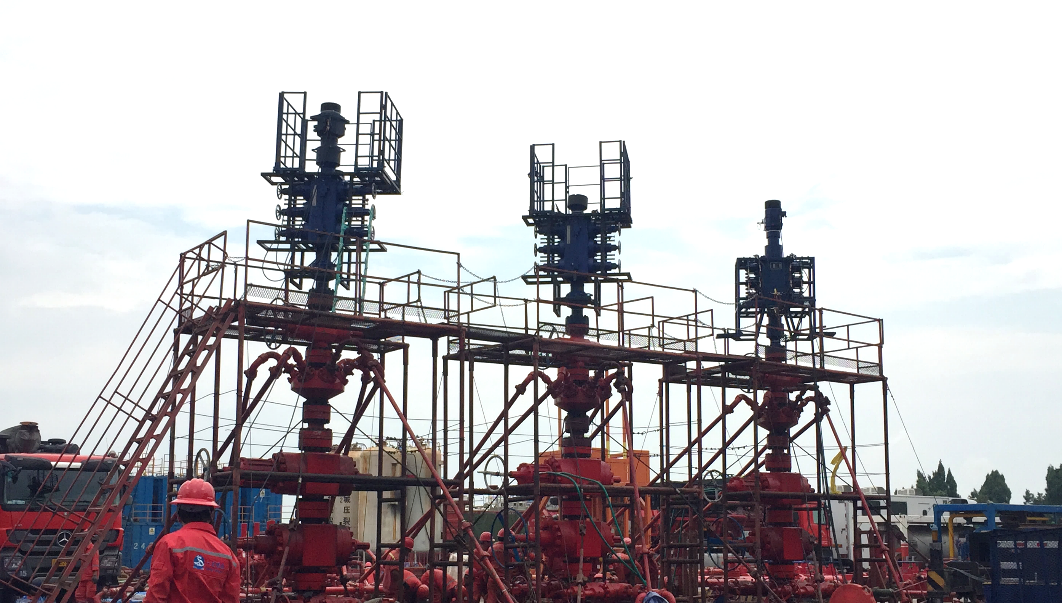
The results show that when the stress stabilization time is two min, the coincidence degree with the indoor and discipline drilling fluid lost control effectiveness is the very best and the analysis result of the drilling fluid lost control performance is “superior.
The minimize in annular return flow will trigger the move speed of drilling fluid while in the annulus to minimize, and also the friction between it as well as annulus will reduce, Hence the BHP and standpipe pressure will lessen linearly with time. As the volume in the drilling fluid invading the fracture improves, the fluid force while in the fracture little by little will increase, thereby decreasing the overbalanced force at both finishes from the fracture. The drilling fluid loss rate slowly decreases as being the overbalanced pressure decreases, the annular return stream adjustments from reducing to raising after some time, as well as the curve of cumulative loss of drilling fluid improves steadily. The drilling website can keep an eye on the distinction between the inflow and outflow of drilling fluid slowly decreases, the reduction in the full pool quantity of drilling fluid for each unit time decreases, along with the velocity of liquid amount fall decreases. With the increase inside the annular return circulation, the BHP and standpipe tension also change from an Original immediate reduce to a boost.
24, which denotes an inverse romance With all the output parameter. In distinction, the effects of gap dimensions is minimum, as evidenced by an R-value of 0.011. Also, the Evaluation reveals that hole size and differential force parameters positively influence mud loss volume. In contrast, mud viscosity and reliable content material are related to a negative impact on the magnitude of the output parameter.
Regardless of the different strategies in place, the phenomenon of mud loss is motivated by various interconnected things, like gap measurement, differential tension in between the wellbore plus the encompassing formations, as well as rheological Qualities of drilling fluids. These parameters can interact in elaborate means, bringing about unpredictable loss volumes, necessitating a comprehensive knowledge of their interdependency. For drilling engineers, predicting the prevalence and quantity of mud loss poses a considerable problem, since the large number of influencing elements may result in sudden and unanticipated adjustments in drilling circumstances, So complicating preventative actions and operational procedures (Pang et al.
The rougher the fracture floor, the upper the coincidence degree with the indoor and field drilling fluid lost control effectiveness, and the greater the analysis final result
The Seepage loss circulation in drilling operations usually happens slowly. It is usually quite challenging to recognize as there may be filtrate loss resulting from bad fluid loss control in a few scenarios. Controlling and stopping seepage losses can be achieved with the right procedure.
For natural fracture-sort loss, the overbalanced force of drilling, that is, the difference between the BHP as well as the development force, often establishes the severity of drilling fluid loss. When the formation stress remains unchanged, the size on the overbalanced force largely relies on the BHP. The BHP during the good circulation of drilling fluid is especially afflicted by the static liquid column pressure inside the wellbore along with the annular strain loss. The depth on the perfectly and also the density with the drilling fluid establish the dimensions from the static liquid column stress within the wellbore. The higher the depth of the well and the density of your drilling fluid, the bigger the static liquid column force while in the wellbore. The annular stress loss is composed of area manifold force loss (pg), inner Software strain loss (pi), bit tension loss (pbit), and annulus strain loss (pa). Due to the simplification of your Bodily model in the numerical simulation of drilling fluid loss in this paper, the affect of pressure loss from the surface area manifold and little bit stress loss over the BHP is dismissed, and just the inner force loss of your drill pipe as well as the interior pressure loss on the annulus are regarded as.
. Through different mitigation actions and technologies, unique methods are applied to beat fluid loss within the occasion of likely and current challenges: The adjustment of fluid density—by introducing products like barium sulfate to increase the density—assists preserve stress balance
Drilling fluid loss is a typical and sophisticated downhole difficulty that happens for the duration of drilling in deep fractured formations, that has an important damaging influence on the exploration and improvement of oil and gasoline means. Setting up a drilling fluid loss design with the quantitative analysis of drilling fluid loss is the best process for your prognosis of drilling fluid loss, which provides a favorable basis for that formulation of drilling fluid drilling fluid loss control steps, such as the knowledge on thief zone site, loss style, and the size of loss channels. The earlier loss design assumes the drilling fluid is pushed by frequent flow or pressure on the fracture inlet. Even so, drilling fluid loss is a posh Actual physical system in the coupled wellbore circulation system. The lost drilling fluid is driven by dynamic bottomhole pressure (BHP) throughout the drilling procedure.
Experimental scheme from the impact of experimental methods around the drilling fluid lost control performance.
This generates a more secure setting for drilling operations and minimizes the pitfalls linked to fluid loss. Furthermore, modifications to drilling techniques can even further mitigate the risk of fluid loss
Once the dip angle with the fracture is 0.5, the coincidence degree with the indoor and area drilling fluid lost control performance is higher plus the evaluation consequence is best
Continuing drilling whilst pumping drilling fluid is 1 option, though ongoing drilling even though pumping drinking water is much less pricey and much more often made use of. From time to time the cuttings from continued drilling will support in cutting down leaks or end losses altogether. A 3rd alternative is to cement the zone where by the losses arise, and to drill from the cement and proceed drilling the nicely. This 3rd choice is fairly often one of the most economical if intense losses take place, as lost circulation sometimes can not be controlled with other strategies.[four]
2nd stage—Unstable loss stage of drilling fluid: As revealed at t = 0–one s in Figure five, the drilling fluid invades The within in the fracture under the motion of overbalanced force. For the reason that fracture outlet is a constant-strain boundary with zero stress, the pressure difference at both finishes in the fracture is the largest at t = 0 s, and the overbalanced tension is equivalent towards the BHP at the fracture entrance. For the time being of loss, underneath the generate of the most overbalanced strain, the movement velocity in the drilling fluid invading the fracture will be the swiftest, as well as the drilling fluid loss rate rises speedily from zero to reach the peak, defining the stream price at this time of loss as being the instantaneous loss rate of drilling fluid. Component of the drilling fluid invading the fracture will trigger the annular return stream to decrease, breaking the dynamic harmony between the inflow and outflow of drilling fluid, Therefore the drilling web page will detect a difference between the inflow and outflow of drilling fluid, the full pool quantity of drilling fluid will minimize, as well as the liquid stage will fall.